Official Celebrations Big and Small

Here in Cameroon there seems to be an endless parade of national and international holidays to celebrate. Some I had at least heard of before. International Women’s Day? Ok, yes, that’s a much bigger deal in a lot of countries that are not the USA. Some I had never actually heard of before coming here and was a little skeptical about. International Bilingualism Day? Is that a thing? I was told that yes, it is an international holiday because Canada is also bilingual. I have no idea if Canadians actually know about this one. Some of them are understandably more important in the Cameroonian context. World AIDS Day? Yeah, I am glad that is at least recognized here, since any opportunity for education on that topic is welcome.

One morning a few weeks ago I woke up to a text about a holiday that I had not even heard about from any Cameroonians until that moment. The delegation for the Ministry of the Woman and the Family was hosting a round table discussion that afternoon in honor of International Family Day. Apparently that is a thing, too.

International Family Day did not actually seem like a huge deal at my post. Nothing was closed and there were no big parties that day, at least not for Family Day. There was just the round table discussion at city hall.

The topic of the discussion was social integration and intergenerational solidarity. The speakers all began after the fashion of many middle school speeches: by defining the individual words that made up the stated topic, starting with the word “social,” an adjective that comes from the word “society,” and so on. They went on to talk about things like reaching across tribal or religious affiliations and being open to the wisdom of older generations.

After an hour or two of this, the floor was opened to questions from the audience. The very first was from an older man sitting right in front of me, who I gathered was a delegate from some ministry or another. His question? Why is it the Ministry for the Woman and the Family? Isn’t the woman already part of the family? What about men? Now I could go on about the place of women in Cameroonian society, but that is not this post. Suffice it to say for now that women in Cameroon, and the Grand North in particular, are marginalized in a way that men are not, and it certainly does not bother me if the Ministry pays them some special attention.

This small recognition of International Family Day was overshadowed, however, by preparations for National Unification Day, commonly referred to simply as May 20th. This is pretty much the biggest holiday in Cameroon. The whole week before the day was marked by things like soccer tournaments and cultural soirées.

The day itself, like all the big official holidays in Cameroon, is kicked off with a parade. Having already been to the Youth Day parade on February 11th, this time I knew better than to show up at 8 a.m. (In my defense, I had been given an invitation to that one that said 8 a.m.) On Youth day they had still been decorating the pavilion and setting up chairs for the invitees when I got there, the first of the invitees. On May 20th I Instead got to the busy stadium around 9:30 and was shown to a seat under the pavilion, because as a Peace Corps Volunteer and white person I am one of the lucky ones who get a shaded chair. Then the lamidos from my town and the surrounding villages started arriving, wearing big robes and surrounded by their notables and accompanied by traditional horn players. A little after 10 a.m. the Prefet got there, and the event could officially start.

The parade went much like the parade for Youth Day, and I imagine Women’s Day, though I did not actually attend that one. The only big difference is what groups march. On Youth Day it was mostly just all the schools and training centers. I believe Women’s Day was mostly Women’s Associations. For May 20th, it is all of the above, but starting off with every military or law enforcement group in the area marching in full uniform, often with rifles strapped across their chests, and saluting the pavilion as they go by. I was a little disappointed that the preschools didn’t march with the rest of the schools like they had for youth day, because even though it is disconcerting that they are taught to march like that at such a young age, they are adorable while doing it.

The rest of the day was hordes of people milling around the stadium, buying from all the food venders, and then more sporting events later in the afternoon. All in all, a big official Cameroonian holiday.

The Lamido/Mayor about to accept a medal before the parade.
By Request

So I have had a couple of requests to write more about my work at post here in this blog. The truth of the matter, however, is that things are just really slow to move along around these parts. The first three months at post are supposed to be for integrating into the community and for needs assessment, rather than starting new projects. Really I was mostly just overwhelmed by the whole moving to an African village all on my own thing. At the beginning there were days when buying beans and beignets for breakfast and then swinging by the daily market felt like a big accomplishment.

I have been here at post for a little over five months, now, though, and things are starting to come together more. Going to the market is not intimidating, I am getting more adventurous in trying new street foods, and even more importantly, I am finding more people to work with. I mean, I am not just here to eat koki and buy pagne, though I have done a lot of both.

The contact I am probably most excited about at this point is the director of the Youth Center here in town. The center currently has about 18 students, for lack of a better word, enrolled in a two year program to train out-of-school youth in things like literacy (French, English, math), technical skills (sewing, business planning), and health education (reproductive health, HIV/AIDS/STIs). I have taken over their English classes, since they had no one else to teach it, and I plan to start teaching life skills classes there as well. The director also actually has plans for other projects, and showed me his schedule of what he wanted to accomplish during the current trimester. He was already a little bit behind, but having plans and a schedule still puts him ahead of the curve around here.

I have also met with the director of the Women’s Center, as well as attended a few meetings of different women’s associations. My impression is that they tend to involve a lot of arguing about money, often followed by food and drink. I have a presentation on goal setting planned for later this month with the widows’ association, so hopefully that is fruitful.

The director of the Government Bilingual Secondary School I actually first met with back before In-Service Training. When I met with him again more recently to discuss what material I wanted to cover with his students, he was very adamant about how I shouldn’t just teach them to abandon their own culture and be like Europeans (I assume he meant Westerners in general). I assured him that the sessions I conducted would be based in local culture. He also wanted me to stress the importance of abstinence and denounce homosexuality as immoral and illegal. I had a cold at the time and was not really in the mood, but I diplomatically told him that if I talked about sex I would include a session on delaying sex and that I had not planned to bring up homosexuality (the reality being that it is illegal). That, however, is a bridge to cross next school year, since classes will basically be over in two weeks’ time.

I did have my first sessions at the bilingual school yesterday, on talking about what the kids wanted their lives to look like in 15 years. It was a struggle to get them to think abstractly, and most students just answered the very specific questions that I asked (What job do you want to have? Do you want to be married? Where do you want to live?), some more seriously than others. The anglophone class was much easier to manage, less because of the language, and more because there were only 8 students and a smaller age range. The francophone class must have been closer to 40 students, aged 11 to 25, all seemingly unable to resist talking to whoever was seated next to them.

In the afternoon, when I was teaching English at the Youth Center, I couldn’t help but be grateful for how orderly the out-of-school youths there were. Again, there were probably only about 10 students present in that first year class, and all closer in age, but there they were, learning about possessive adjectives in appropriate silence and responding when called on. Tomorrow, however, it will be back into the trenches of the Government Bilingual Secondary School, francophone class first.

Hot season is winding down.

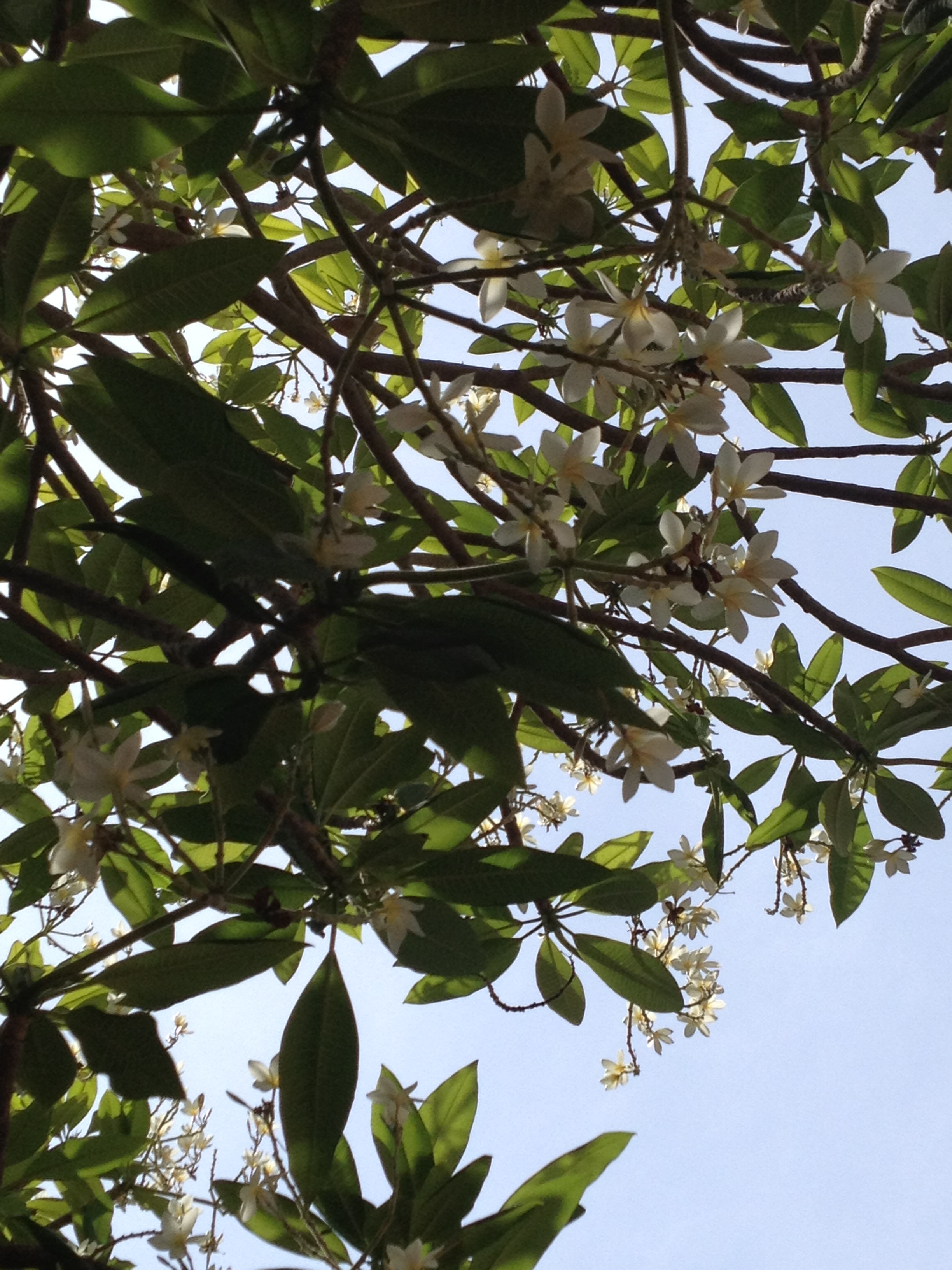
The plumeria are in bloom around Garoua.

The plumeria are in bloom around Garoua.

I’m in Garoua again for a meeting later this morning. It is amazing the change in weather just between here and my post.

At my post, hot season is already winding down. The market is still full of mangoes, and most days still feel hot and dry, but the rains that started as a teasing five minute sprinkle at the beginning of April have slowly become heavier and more frequent. They bring a brief respite in the form of cooler temperatures and fresher feeling air, but the heat is usually back a day later, often with a touch (or maybe an uncomfortable slap) of humidity. Still, either the temperatures are starting to trend down down, or I am getting more used to the heat. Or maybe visiting Garoua just makes my post seem cooler by comparison. It is pretty much the hottest place in Cameroon.

Two nights ago I was on the phone with someone who was in Ngaoundere, where is was pouring rain. The power was out at my house, and it was getting dark, so I was sitting on my porch where there was still a bit of light left, and watching the storm clouds gather in the sky, the winds already making the temperature drop more quickly than most evenings (to really pleasant, no cold). An hour or so later, the rain started coming down, leading the the biggest storm so far this season. I went to sleep to the sound of rain pounding on my tin roof.

The next morning it had stopped, all the better for traveling. They have been working on the road between my post and the main road, and it has gotten a lot better, but it is not paved yet. Still, I got to Garoua in my fastest time yet: just under three hours. I asked people here if they had had rain the night before, and to my surprise I was told that no, the rain did not make it up to Garoua.

All I can say is thank goodness for the air conditioning in the Garoua office. That, and the fast wifi.

Mango Season

During Pre-Service Training we all had interviews with our Program Managers about how we were getting on and what we wanted out of our posts. I told Amadou that what I really did not want was a lot of heat. Yes, there are places in Cameroon that are not terribly hot. There are posts in the North West where temperatures are in the 70s for much of the year. I have heard that there’s a town in the mountains of that region where it even gets down to the 40s.

To be fair, I did specify that it was humid heat in particular that I could not stand, but I wanted as little heat as possible.

Ever since I first got to the North, people have been telling me about hot season. I’ve heard that I would be dumping water on myself with my clothes still on to keep cool. I have heard that if I have a walled concession, I should just sleep outside at night, or alternatively dump water all over my bed and just hope to fall asleep before it finishes evaporating. I’ve been told not to worry, because once you get to 100 or 110 degrees, everything after that pretty much feels the same, anyway.

Now that it is March, hot season is officially here, and should continue (and probably get hotter) until the rains start in May. I have no way of knowing the current temperature at my post, except to look up the forecast for Garoua (high of 106 for today) and assume it is at least a little bit lower (my town does have the reputation of being on the cool side for the North – thanks, Amadou!). I have not gotten to the point of dumping water on myself while clothed, or sleeping on a wet mattress – so far. This is especially good, since the water pump closest to my house seems to have stopped working, so every ounce of water has to be hauled twice as far under the blazing sun.

But there is a bright spot in all this. For the last week or so I have been gazing longingly at small green fruit that seem to be dripping from the branches of the trees around here – and today I purchased and ate my first mangos of the season!

Now I just can’t wait to be able to plug in my fridge and actually drink some cold water.

Beaches, Waterfalls, and Fish Mamas

IMG_0369

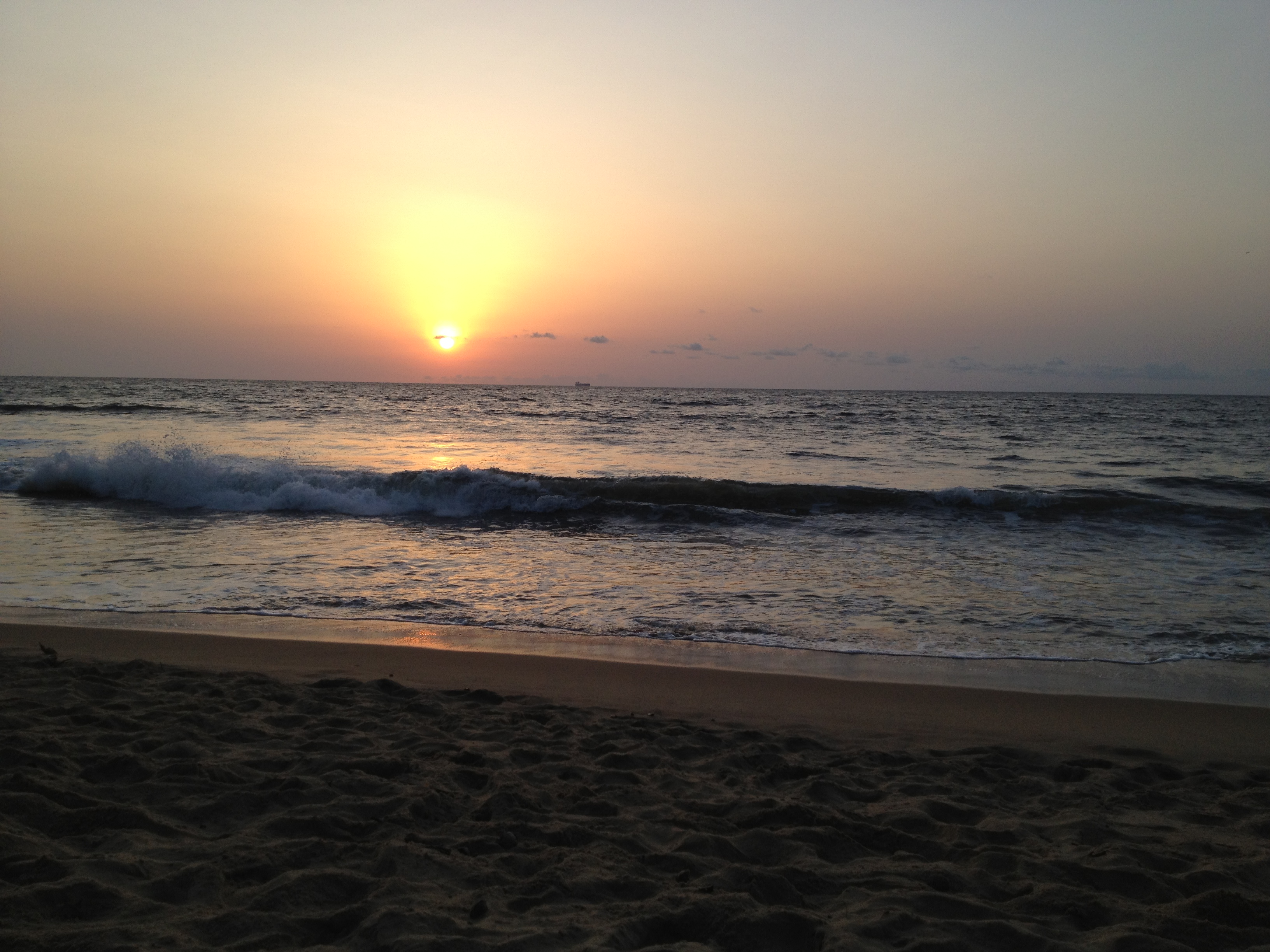
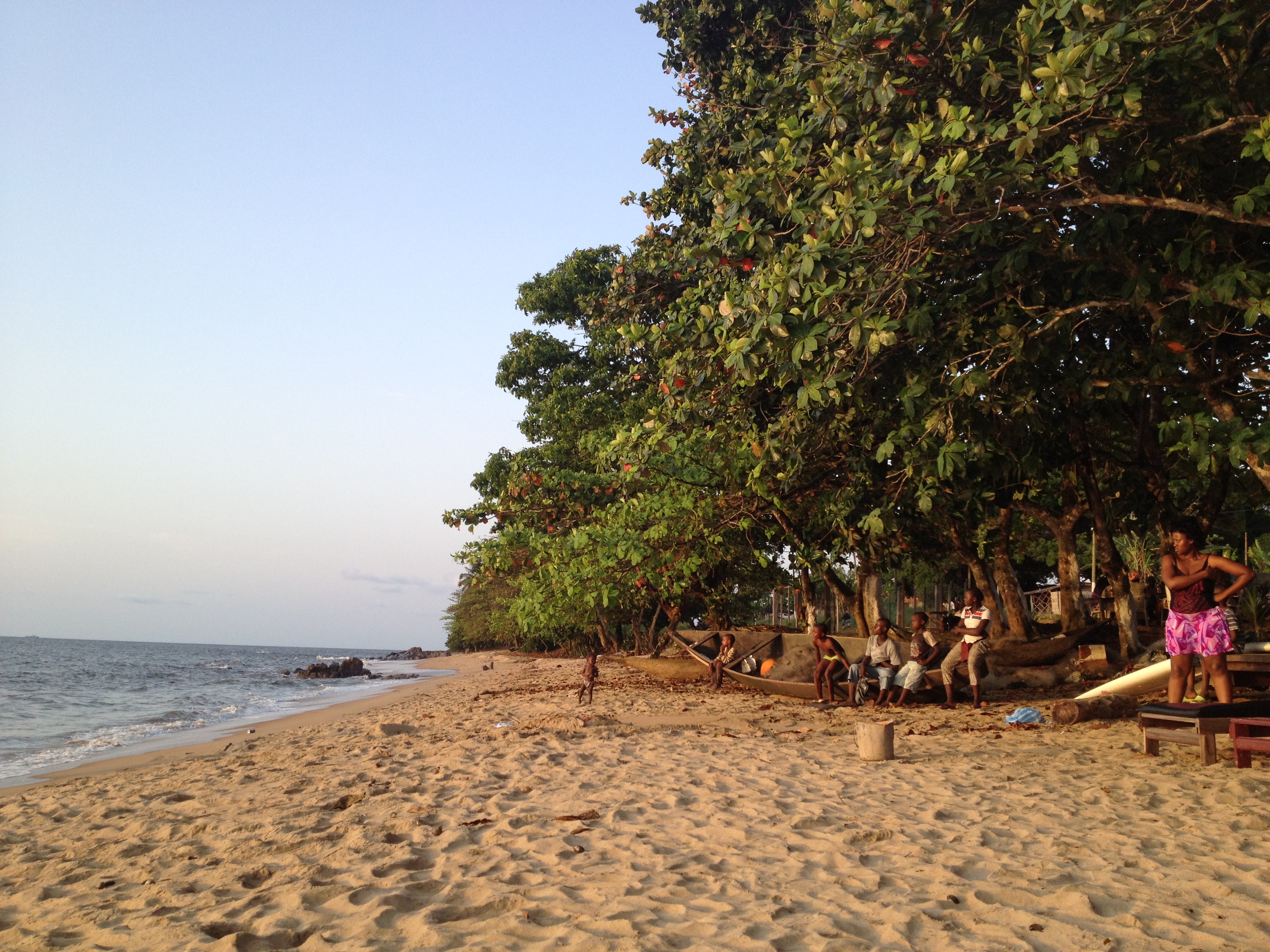
Hangin’ on the beach in Kribi

Just last night I got back after being away from post for 3 weeks, most of which was spent at an in-service training in a town outside of the capital. It was good to see everyone in my training group again, and less exciting to sit in sessions all day. But after two weeks of boredom punctuated by two intense games of sock assassins, about half of us rewarded ourselves by taking off to Kribi.

Kribi is a beach/port town in the South region of Cameroon, known for having a freshwater waterfall that falls directly into the ocean and also the best seafood in Cameroon. I am going to go ahead and say that from what I have experienced, it also has the best pizza (though unfortunately the night I went they were out of seafood pizza).

Now my favorite Cameroonian dish by far is definitely poisson braisé (which, from what I can find on the Internet, is called “burning fish” in Anglophone Cameroon). It is basically just a whole fish cleaned, scaled, and brushed with a spice mixture before being grilled over hot coals and served with more spice mixture, piment sauce, and sometimes mayonnaise and/or baton de manioc on the side. Yes, the head is still attached, and plenty of Cameroonians will tell you that the head is the best part. Poisson braisé is not available at my post, where fish that isn’t smoked or dried is rarely ever seen. In cities with bar neighborhoods, however, it is typical to see fish mamas set up along the street waiting for you to pick out one of their fish for them to grill up and bring to your table in whatever bar you’ve decided to sit in and order a beer or soft drink.

My first poisson braisé experience in Kribi was like this, making it similar to several nights in Garoua, except that the fish mama had a much wider selection of fish (barracuda, anyone?), all of which had probably still been swimming that morning. And then we found the fish market. This is where you can find fishermen emptying nets full of fresh fish onto cement slabs ready to sell to the crowds, as well as a whole bunch of fish mamas set up with their own tables looking out on the marina, ready to gill some fresh fish. You can choose from the fish the mama already has on hand or go haggle with a fisherman yourself and then just pay a fish mama to cook it for you. A glass of fresh pineapple juice makes the meal complete. I went back the next day, too.

Unfortunately, my last night in Kribi I got sick, and I don’t mean that I had a bit of a cold. I mean standing in the bathroom and trying to decide if the next round would be vomiting or diarrhea sick. 3 month in an out of the way village, and of course the first time I come down with anything more than the sniffles would be in one of the most touristy towns in Cameroon. But hey, I was recovered enough to travel the next morning, and a course of cipro and a lot of white bread and clean water later, I am back at post and eating street food again.

There are some pictures up on Flickr, both of Kribi and my post, including the Youth Day festivities that went on the week before I went to in-service.

IMG_0380

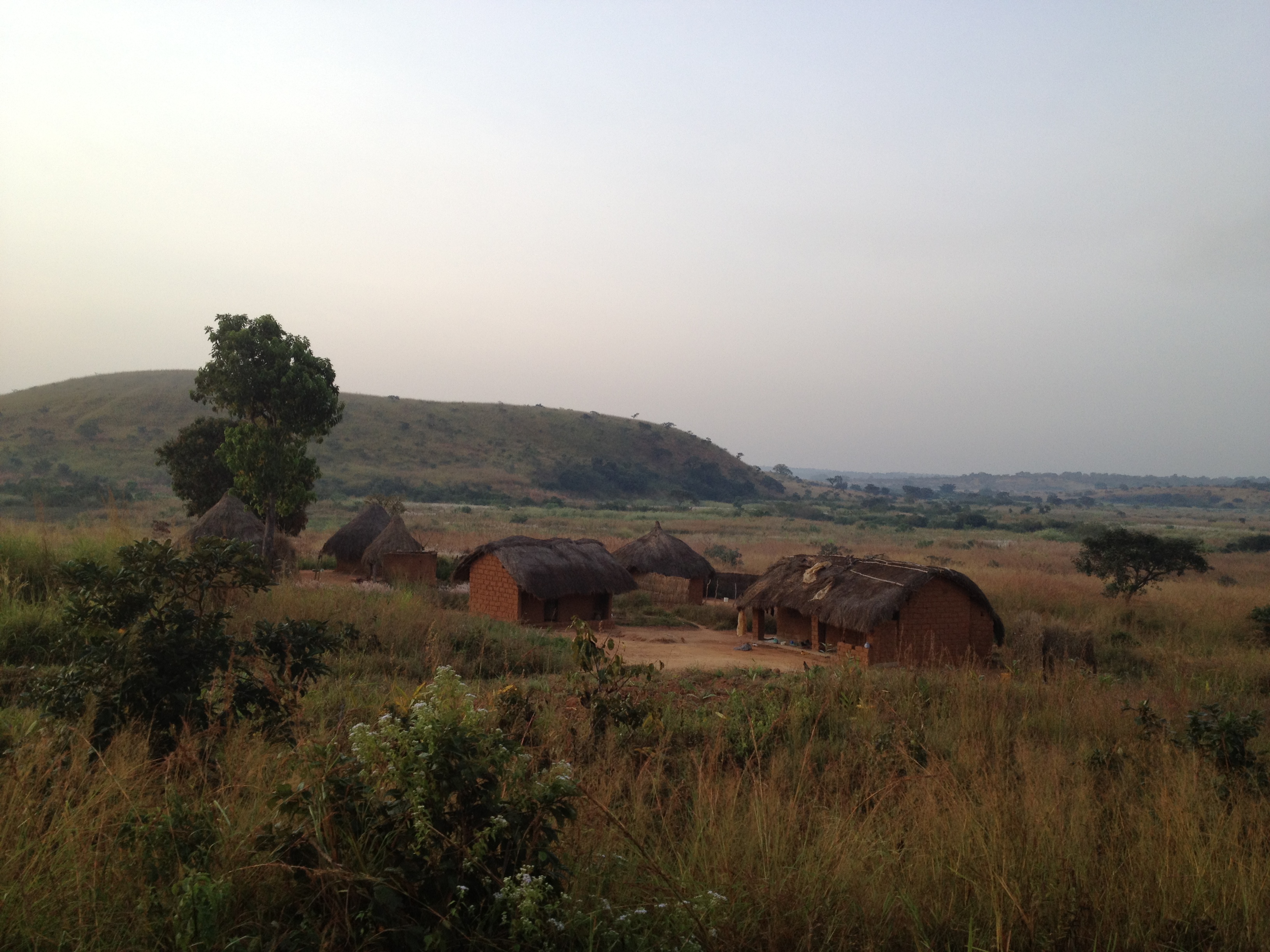
This looks like it could be California, but it is Cameroon, really.

Also, if any of you have been following news of Africa, you should know that I am safe, the kidnappings happened in the Far North and not anywhere near my post, and the Peace Corps is keeping on top of things and being fairly conservative about the safety of volunteers. So in short, there is no need to worry about me, because there are plenty of people in Yaoundé doing it for you!

Holidays and Travel in Cameroon

First view of the Grand North

This is the view in the morning on the overnight train from Yaounde to Ngaoundere.

So it has now been two months since I first got to my post. Sorry about that. I suppose I have not been the best blogger so far. In my defense, the Internet has been difficult, lately.

I possibly have not been the best Peace Corps Volunteer either, since I have also already left my post three times since I first got to it. Fortunately for me, traveling over the holidays seems to be pretty standard in Cameroon. Government workers, who are often posted far from home for work, get a month off every year. Those that can afford it often use their month of vacation all at once to see their families for the holidays. So, even though my new town is mostly Muslim, people are not particularly surprised to hear that I’ll be away for a few days for Christmas or New Years – both national holidays.

The first time I left post, however, was not actually for a national holiday, but instead for a cultural festival in Guider. Guider is a small city about halfway in between Garoua and Maroua, but still in the North Region. The trip involved watching some cultural dances and rituals that led into the festival, as well as a visit to the nearby Gorges de Kola – awesome rock formations that are apparently completely covered by water in the wet season.

I spent Christmas in Garoua with other Volunteers. We made a feast in the Peace Corps office on Christmas Eve and read Christmas stories. On Christmas morning we had a white elephant gift exchange followed by an awesome brunch involving homemade Dutch oven bagels.

For New Years I went to Lagdo, another town in the North Region. It is located next to Lake Lagdo, a large man-made (by the Chinese) lake that provides power and fish for most of the region. There are currently three Volunteers posted there, and one of them was nice enough to host all the Volunteers from my training group who are in the North Region in a night of Mexican food and New Years fun.

All this travel has left me a lot more confident about how to get around Cameroon, at least in the Grand North. I have found that even if it is not always easy to get directly from one place to another here, it is just a matter of finding a way to your next turn or intersection, where you can then find a way to the next. This is less complicated than it probably sounds; there aren’t actually that many turns or intersections to deal with. When I leave Garoua to return to my post, it is just a matter of getting on a bus going south toward Ngaoundere, and making sure the bus driver knows at which intersection I’ll be getting off, about halfway along. Then, at that stop, it is simple enough to find a ride going the whole rest of the way along the one road to my post. It is normal for cars and buses to stop along the way from one destination to the next to let people on or off. It is just a matter of planning , as with many things in Cameroon, plenty of buffer time for when things take a little longer than you think they should – as well as excepting cramped quarters and that at least one of your fellow passengers may well be a live chicken.

Just today I got back from Garoua again for a trip to the bank and a regional meeting (and the Internet was down the whole time I was there). On Thursday I made it from my post to the city in record time – about three hours. And half of the trip was even spent in the height of comfort on Cameroonian public transportation: an aisle seat on a big Touristique bus. Today I got lucky again, but the trip back has taken up to seven hours. Delays so far have included waiting for the next bus that is not already full to leave Garoua (I have waited 3 hours at the bus station), waiting for flat tires to be fixed, or just having found myself in an excruciatingly slow-moving minibus crammed between other passengers sitting 5 to a row in rows built for four.

The 50th Anniversary of the Peace Corps in Cameroon

The 50th anniversary celebration was on Wednesday – and was also our Swearing In Ceremony! It was kind of a big deal.

Normally the swearing in ceremonies are held in the same town as training, and all the host families are invited. Instead ours was at the Palais de Congres in Yaounde, with the Prime Minister of Cameroon as the guest of honor, and a fair afterward that was kicked off by the First Lady.

So Wednesday morning all of the trainees had to be on the busses in Bafia, ready to go, along with one member of our host families each that we could invite to the ceremony, by 6:00 a.m. We had to make sure that we arrived in Yaounde in time to all be seated by 9:30 before all the ministers, including the Prime Minister arrived. In the end he just ended up sending a representative, as did the US ambassador (it was the guy whose wife I sat with at the dinner at the CD’s house). The ceremony involved a lot of speeches (including one that I gave in French as a representative of my training group), gifts to officials, an ok rendition of Man in the Mirror sung by us and a small Cameroonian choir, and the actual swearing in. Now all 53 of us are Volunteers!

Afterwards we were herded downstairs to the big entrance hall to await the arrival of the First Lady, Chantal Biya. She was there as the head of her NGO, which I believe supports mothers and infants in Cameroon. If you haven’t, you should google a picture of her. When she arrived, she and the Country Director went arround to each of the booths set up, representing each region of Cameroon and each sector that the Peace Corps works in to formally view them.

Those of us that were now newly sworn in volunteers then had a buffet lunch with those members of our families that were there before heading down to look around the fair ourselves. I mostly just hung out at the booth for the North Region, talking to the volunteer who is just finishing her service at what is now my post. It was awesome to meet Dori and ask all the random questions that I have about where I’ll be living. And now I have the keys to my house!

After that was the bus ride back to Bafia, a party just for us to celebrate our new volunteer status, Thanksgiving in Bokito the next day, and then the long trip up to the North. Those of us posted in the Grand North all took an overnight train from Yaounde to Ngaoundere on Friday night, and then we had about a five hour bus ride to get here to Garoua, my regional capital. Those of us with posts in the North are here for the weekend, and to open bank accounts and do some protocol tomorrow (Monday), and then we’ll be off to our posts on Tuesday.

That’s right, I’m getting a new home for my birthday!

I’ll try to get a couple pictures us soon, but the wifi is being a little finicky at the moment.

Into the West

IMG_0165

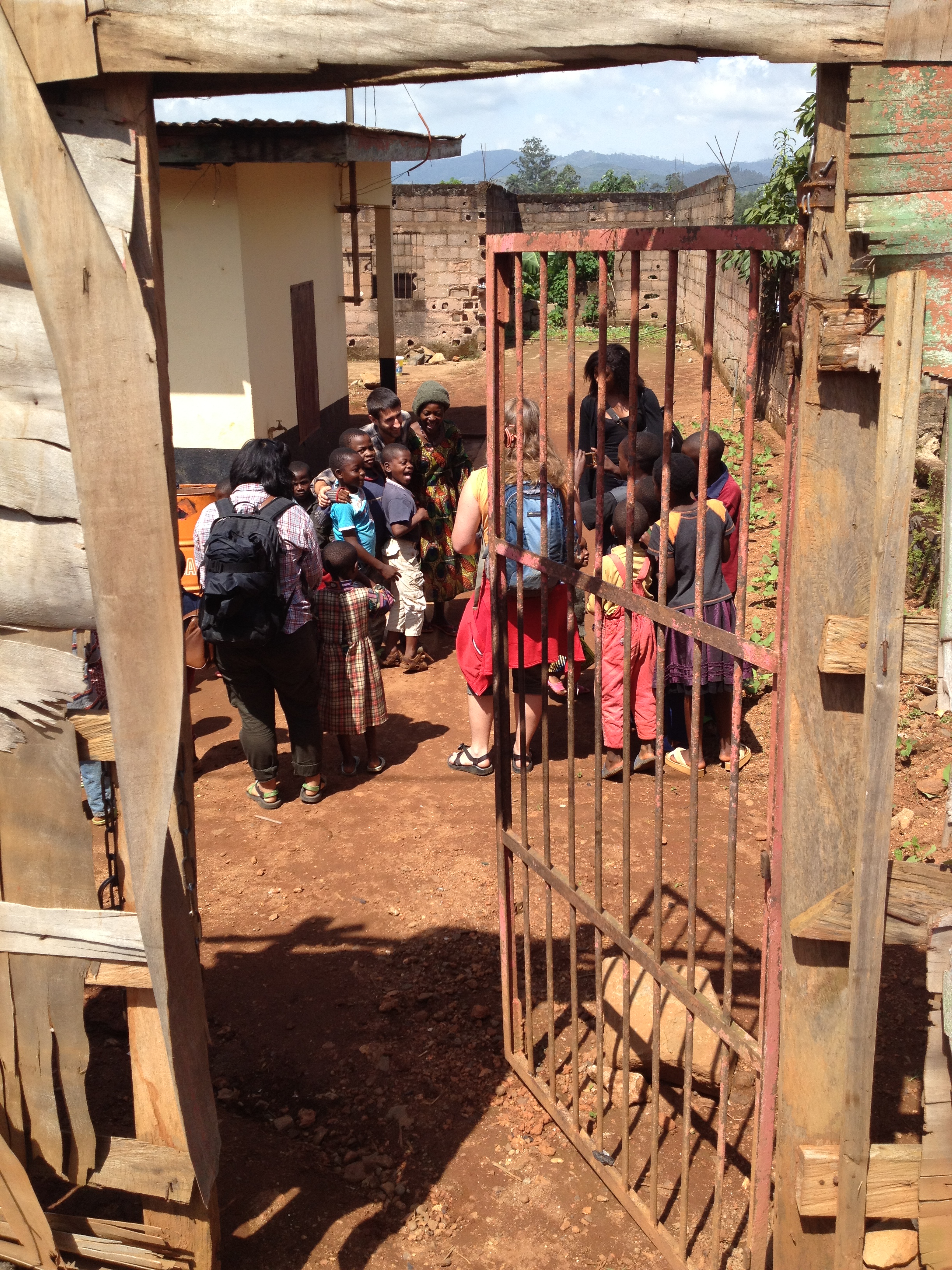
The CIBAEEVA Orphanage in Dschang

Last weekend the Youth Development trainees got to go on a one night field trip to the West Region of Cameroon. So last Friday after lunch we piled into a little bus and were on our way to spend the night in Bafoussam, the regional capital. The bus was a hot tin can until we opened some windows and let the wind blow in our faces. The landscape was green with periodic patches of burgundy soil.

We didn’t have anything in particular planned for our evening in Bafoussam, but the cooler Western air was a welcomed change to our Bafia routine, as were the shawarma sandwiches and fries we got for dinner, and the hotel showers. Really though, that shower was amazing: warm with just enough shower pressure. My hair felt so clean after mine. Kevin took two.

The next morning it was back into the bus, and farther into the West Region until we got to a town called Dschang (as far as I can tell the D and S are silent). In Dschang we were able to visit the CIBAEEVA Orphanage, which was started by a Cameroonian school teacher and cares for many children from the community whose parents are either dead or, more often, unable to care for them. CIBAEEVA keeps the kids in school, as well as giving them a place to eat in sleep, and here in Cameroon school can be expensive. Even if there are no fees for government primary schools, there are often mandatory PTA fees, and books and uniforms have to be bought, too.

Next on the itinerary was a cultural museum, also in Dschang. I thought it was very well put together, but after learning about the orphanage and playing with the kids, it was almost noon by the time we got to the museum, and we had to get back to Bafoussam before we could have lunch. Then it was back to the hot, humid heat of Bafia. Of course Cameroon would just start to get hotter in November.

I did upload pictures of the trip to my Flickr photostream a few days ago. In case anyone hasn’t figured it out yet, you can find the link to that by scrolling to the top of this page and clicking on the link that says “Pictures.” If anyone is still having trouble, though, let me know.

Water!

So I have now been in Bafia, Cameroon, for what, three or four weeks? It is currently the rainy season, and I keep remembering what someone told me about a week before I left the US: Cameroon in the rainy season is characterized by a lot of mud, and Cameroon in the dry season in characterized by a lot of dust. I’ve definitely gotten to experience some of that mud.

Bafia, I am told, is pretty modern and developed for Cameroon (especially compared to some of the places that a lot of us will be posted), but it probably shouldn’t surprise you to hear that I live on a dirt road that quickly turns to mud in the rain. I do, however, have a bathroom in my homestay house, complete with a sink, a toilette, and a shower head with a drain underneath it – and water doesn’t come out of any of them. Instead, I or others in my family have to go to the well in the yard across the street to carry water for use in the bathroom.

Luckily, the water that comes out of that well is clear, and I suspect treated, because a lot of other trainees and their families have to go all the way to the water pump to get water that clear, and man, is water heavy. Still even with the clear and probably treated water, I chlorinate it and put it through a Peace Corps issued filter before drinking it. A couple of trainees have had amoebas, and another found a round worm in the top (unfiltered) part of her water filter that definitely wasn’t a worm yet when she put the water in, and those are things I would like to avoid ingesting for as long as possible. Fresh fruits and veggies have to be soaked in water with bleach before being eaten raw, and other foods, especially involving water, have to be heated to a boil.

Laundry water does not need any special treatment, but it is a whole different experience to do that by hand and then worry about having enough sun to be able to dry it outside during the rainy season. Of course by the end of November I am told it will be the dry season again, and quite hot. By January Bafia’s wells will be running dry, and everyone will have to go to the water pump.

Of course by then I will be at my own post, and the whole water situation will probably be completely different.